


Best Ethereum RPC providers for production workloads in 2026


The best Ethereum RPC provider in 2026 depends on three metrics:
- monthly request volume,
- peak requests per second, and
- compliance.
We compared eight Ethereum RPC providers using these metrics, with every figure taken from the provider's own pricing page on Oct 15, 2026.
Normalized to 100M eth_call-type requests per month on a shared plan,
- OnFinality (249) and Dwellir (299) are the cheapest.
- Chainstack ($449) gives the most requests per second below 600 RPS on a flat per-request model, and is the sole provider with SOC 2 Type II and ISO 27001 across all plans.
- Credit-weighted providers (Quicknode, Alchemy, Infura, Ankr, GetBlock) cost 2–4x more for the same call mix.
The comparison table sorts by throughput on the entry plan, with cost at 100M requests alongside. The use-case section shows the outcome, and the provider sections dive into the details of each subscription.
Ethereum RPC providers compared
Sorted by requests per second on each provider's lowest monthly plan; ties are broken by requests included in that plan.
Alchemy and Ankr have no monthly tiers and are listed last with their usage-billed throughput. "Weight" is what one eth_call costs in the provider's own unit; see the methodology for how it was converted.
1. What does 100M RPC requests cost?
Estimated monthly cost for 100 million Ethereum eth_call requests, sorted from lowest to highest based on the comparison assumptions.
Swipe sideways to view the entire table.
| Provider | Est. monthly cost | Plan / pricing basis | Rate limit |
|---|---|---|---|
| OnFinality | $249 | Accelerate 100M response units | 500 RU/s |
| Dwellir | $299 | Growth 150M responses | 500 RPS |
| Chainstack | $449 | Pro + overage $199 plan + 20M extra calls | 400 RPS |
| GetBlock | ~$839 | Premium + top-up 1.6B CU + 400M extra CU | 800 RPS |
| QuickNode | $999 | Business 2B API credits | 500 RPS |
| Alchemy | ~$1,365 | Pay as You Go 2.6B compute units | 300 RPS |
| Ankr | ~$1,667–$2,000 | Deal-rate equivalent / PAYG See pack-purchase caveat below | 1,500 RPS |
| Infura | Custom quote | Custom 100M calls exceeds the stated Team allocation | Not quoted |
Rates are based on each provider's stated eth_call billing weight. RU/s is not necessarily equivalent to RPS for higher-weight methods. A published plan's rate limit does not guarantee a contractual SLA.
How were the 100M-request costs calculated?
- OnFinality: Accelerate includes 100M RU at $249, assuming 1 RU per standard request.
- Dwellir: Growth includes 150M responses for $299.
- Chainstack: Pro costs $199; 20M additional calls at $12.50 per million add $250. Business costs $499 and includes 200M calls (600 RPS).
- GetBlock: Premium costs $699 for 1.6B CU; an extra 400M CU at $0.35 per million adds $140.
- QuickNode: Business includes 2B API credits for $999, at 20 credits per standard call.
- Alchemy: 100M calls × 26 CU = 2.6B CU; at $0.525 per million CU, the total is $1,365. Extra throughput is charged separately.
- Ankr: 100M calls × 200 credits = 20B credits. The ~$1,667 figure uses the effective rate of $500 per 6B-credit deal pack. If only whole packs can be bought, four packs cost $2,000 upfront, with 4B credits left over; PAYG also totals $2,000.
- Infura: The $225 Team plan covers about 28M calls per month; pricing for 100M calls requires a custom quote.
2. Free tiers and starting prices
Each provider uses a different billing unit. The smaller text beneath its name shows the unit weight of a typical Ethereum eth_call.
Swipe sideways to view the entire table.
| Provider / call weight | Free tier / trial | Entry paid plan | Cost / 1M calls |
|---|---|---|---|
| OnFinality 1 RU / call | 400K RU/day 40 RU/s | Growth · $49/mo 20M RU · 200 RU/s | $2.45 |
| Dwellir 1 response / call | 500K/day 20 RPS | Developer · $49/mo 25M responses · 100 RPS | $1.96 |
| Chainstack 1 unit / call; archive 2 | 3M calls/mo 25 RPS | Growth · $49/mo 20M calls · 250 RPS | $2.45 |
| GetBlock 20 CU / call | 50K CU/day ~2.5K calls/day · 20 RPS | Starter · $49/mo 90M CU (~4.5M calls) · 250 RPS | $10.89 |
| QuickNode 20 credits / call; trace/debug 2× | 10M-credit trial 1 month · 15 RPS | Build · $49/mo 80M credits (~4M calls) · 50 RPS | $12.25 |
| Alchemy 26 CU / call | 30M CU/mo ~1.15M calls · 15 RPS | PAYG · no monthly tier $0.525 / 1M CU · 300 RPS | $13.65 |
| Ankr 200 credits / call | 200M credits/mo ~1M calls · ~30 RPS | PAYG / Deal packs $0.10 / 1M credits; $500 / 6B-credit pack | $20 PAYG $16.67 deal-rate equivalent |
| Infura 80 credits / call | 3M credits/day ~1.1M calls/mo | Developer · $50/mo 15M credits/day (~5.6M calls/mo) · 50 RPS | $8.90 |
Entry pricing is the plan price divided by its included eth_call equivalents, or the stated usage/deal rate. It is not necessarily the price of additional calls. QuickNode's free offering is a one-month trial, not a recurring free tier.
3. SLA and compliance comparison
Published uptime claims, contractual service-level agreements, and compliance attestations are distinct.
Swipe sideways to view the entire table.
| Provider | Uptime / contractual SLA | Audits / compliance |
|---|---|---|
| OnFinality | 99.99% uptime stated; no self-serve SLA | None found in source |
| Dwellir | 99.99% SLA on paid plans (stated) | None found in source |
| Chainstack | 99.99%+ shown on status page ; contractual SLA on Enterprise | SOC 2 Type II; ISO 27001 on all plans |
| GetBlock | SLA on paid plans; 99.99% on dedicated | SOC 2 Type II (attested Q2 2026) |
| QuickNode | Contractual SLA on Enterprise | SOC 1; SOC 2 Type II; ISO 27001; DORA on Enterprise |
| Alchemy | Signed SLAs on Enterprise | Not verified in source |
| Ankr | Contractual SLA on Enterprise only | None found in source |
| Infura | No SLA on self-serve plans | Not verified in source |
Source: original provider comparison supplied for this article. Prices, rate limits, SLA claims and certifications have not been independently reverified for this code version. "None found" or "not verified" does not prove a provider lacks a certification. Verify details with each provider before publishing a buying recommendation.
One thing the table does not show: the free tiers are not comparable.
- Chainstack's 3M / month
- Dwellir's ~15M / month
- OnFinality's ~12M requests/month
These are all 3–13x larger than Alchemy's ~1.15M, Infura's ~1.1M, and GetBlock's ~75K once request weights are applied.
How we compared Ethereum RPC providers
Prices, limits, and method weights were taken from each provider's public pricing and documentation pages on Oct 15, 2026; every provider name in the table links to the page used.
Monthly list prices are shown; annual discounts (15–20% at most providers) are ignored so the plans compare like for like.
Normalization
Compute units, credits, and response units were converted to requests using each provider's published weight for eth_call on an Ethereum full node: Chainstack 1 request unit, Dwellir 1 response, OnFinality 1 response unit for standard methods, GetBlock 20 CU (chain multiplier 20 x method multiplier 1), Quicknode 20 API credits, Alchemy 26 CU, Infura 80 credits, Ankr 200 API credits. Where a provider publishes a flat weight for all Ethereum methods (Quicknode, Infura, Ankr), the number holds for any read-heavy mix. Where weights vary by method (Alchemy, GetBlock, OnFinality), a mix heavy in eth_getLogs, trace, or debug will cost more than shown; Alchemy's own guidance is to assume 27 CU per request on average.
"100M requests" column
The cheapest self-serve plan, or plan plus published overage, that covers 100M such requests in a month. Enterprise and custom quotes are excluded. For Alchemy and Ankr, which have no monthly tiers, the figure is pure usage billing.
Uptime
"Measured" means a public status page with history; "SLA" means a contractual figure on the named plan; "stated" means a marketing claim with no public data behind it. We did not run latency benchmarks for this edition, so no latency figures appear in the table.
For live latency by region, Quicknode, Alchemy, and GetBlock publish their own benchmark pages, and Chainstack publishes a public performance dashboard; each is run by the provider, so use it as a reference.
Attestation
"None found" means no SOC 2 or ISO 27001 statement appears on the provider's pricing or plan pages. It does not mean the provider is uncertified; ask for the report during vendor review. Alchemy and Infura both publish security pages we did not audit for this edition.
Scope
Shared (multi-tenant) plans only. Dedicated nodes, unlimited or limitless nodes, and dedicated clusters are covered in the provider sections because their pricing is per node or per RPS tier and does not reduce to a per-request figure.
Best Ethereum RPC provider by use case
Each block names three or four candidates and the one measurable reason to pick each. The provider sections below carry the detail.
Stablecoin and payments infrastructure
Priority: an uptime commitment you can put in a contract, and a bill that does not move when transfer volume spikes.
- Chainstack — 99.99%+ measured on a public status page, flat 1 RU per call so a surge in eth_getTransactionReceipt polling costs the same per call as anything else, contractual SLA on Enterprise from $990/mo.
- Quicknode — contractual SLA plus SOC 1, SOC 2, ISO 27001, and DORA reports on Enterprise; credit billing at a flat 20 per Ethereum call is predictable for read-heavy payment flows.
- Dwellir — 99.99% SLA stated on every paid plan from $49, and $299 covers 150M responses; no audit attestation found, so confirm compliance documents first.
- Infura — MetaMask-native and widely integrated, but no SLA on self-serve and the daily (not monthly) credit quota means a one-day spike can hit a 402 before month end.
Enterprise and regulated workloads
Priority: audit reports your vendor review will accept, SSO and RBAC, and a signed SLA.
- Chainstack — SOC 2 Type II and ISO 27001 published for all plans; SSO from Pro (199), RBAC from Business (499), uptime SLA on Enterprise.
- Quicknode — the broadest attestation set in this comparison (SOC 1 and SOC 2 Type 2, ISO 27001, DORA), but only on Enterprise; SSO and RBAC are Enterprise-only too.
- GetBlock — SOC 2 Type II attested in Q2 2026, company-wide; SSO and RBAC on Enterprise from $999.
- Alchemy — signed SLAs, SAML SSO, and RBAC on Enterprise; attestation not verified in this edition.
Indexing, analytics, and NFT backfills
Priority: archive and trace access without a multiplier that makes historical replay 2–4x the price of live reads.
- Dwellir — trace and debug on every paid plan at 1 credit per response, no archive surcharge found on the pricing page; a dedicated Ethereum archive cluster is listed at $12,600/mo for unmetered access.
- Chainstack — archive at 2 RU per call, debug and trace included from Growth ($49); Unlimited Node add-on from $149/mo (25 RPS) removes metering for a backfill job.
- OnFinality — archive on every plan, including free; trace API from Growth ($49); response units are weighted by method, so budget on actual trace volume.
- GetBlock — archive mode doubles the CU cost (40 CU per standard call, 80 for trace); Limitless Node archive tier from $150/mo at 15 RPS caps the bill for long backfills.
High-throughput shared plans
Priority: RPS ceiling on a shared plan before dedicated infrastructure becomes necessary.
- Ankr — 1,500 RPS on Premium at pay-as-you-go rates with no plan to pick, at the highest per-request cost ($20 per 1M).
- GetBlock — 800 RPS on Pro (499) and Premium (699).
- Chainstack — 600 RPS on Business ($499); above that, Enterprise with custom RPS or Unlimited Node tiers up to 500 RPS per node.
- Dwellir — 5,000 RPS on Scale (999), the highest shared ceiling in this comparison;500RPSonGrowth(299).
- Quicknode — 500 RPS on Business ($999); Alchemy — 300 RPS included on Pay as You Go, then $160/mo per 5,000 CU/s block up to 30,000 CU/s.
Ethereum RPC provider reviews
Same order as the table. Each section states pricing as published, then what the provider is best at and where it loses.
OnFinality
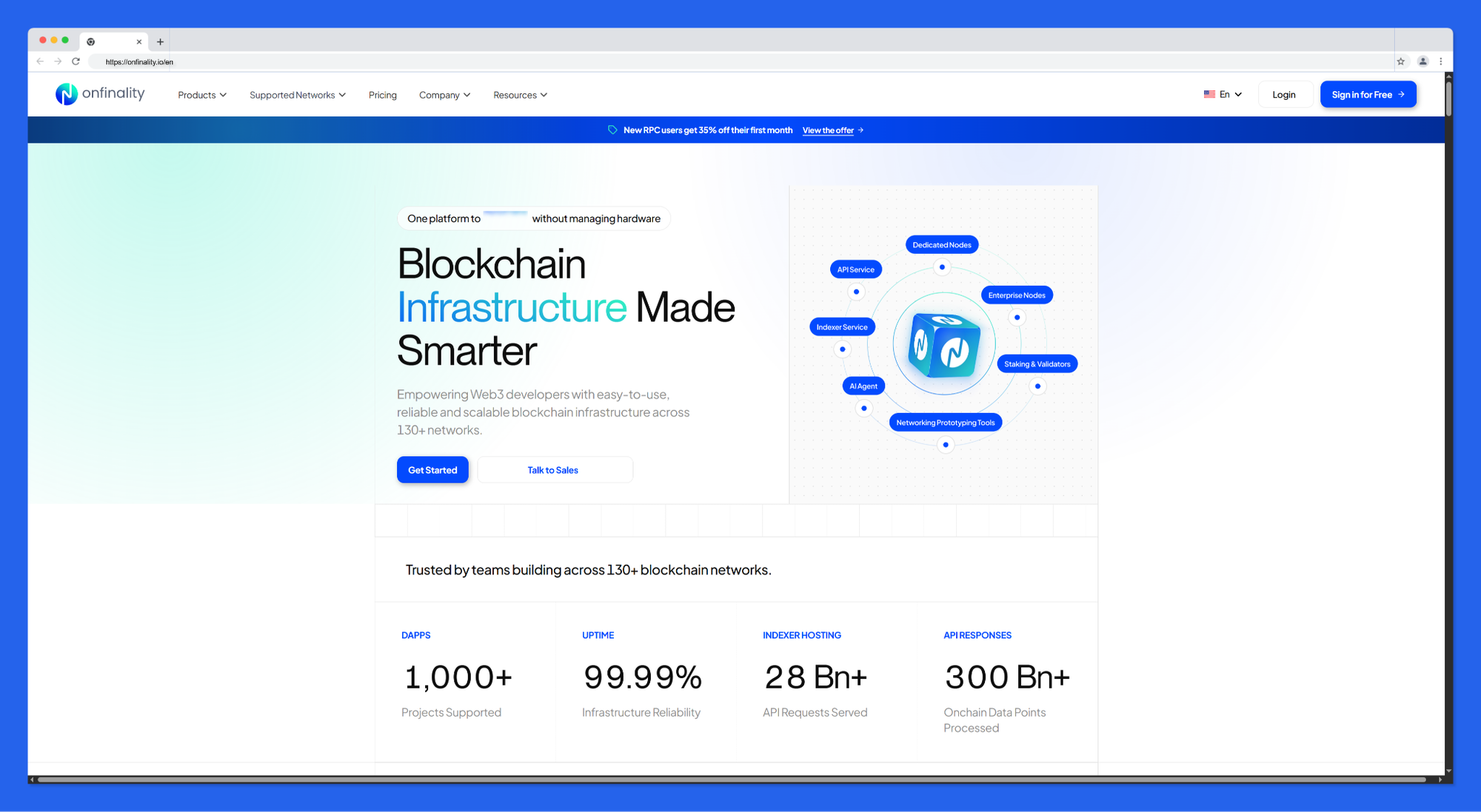
OnFinality sells Ethereum RPC on four tiers: Developer (free, 400K response units per day, 40 RU/s, archive included, no trace), Growth ($49, 20M RU, 200 RU/s, trace API, 6perextra1MRU), Accelerate(249, 100M RU, 500 RU/s, $3.75 per extra 1M RU), and Ultimate (custom). Standard requests count as one response unit; heavier methods are weighted. Dedicated nodes are pay-as-you-go on every tier.
Best at: lowest published price for 100M standard requests ($249) and archive access on the free tier. Loses on: 99.99% uptime is stated, not contracted, on self-serve plans; no SOC 2 or ISO 27001 statement found; the Ethereum public endpoint is rate-limited and not for production.
Dwellir
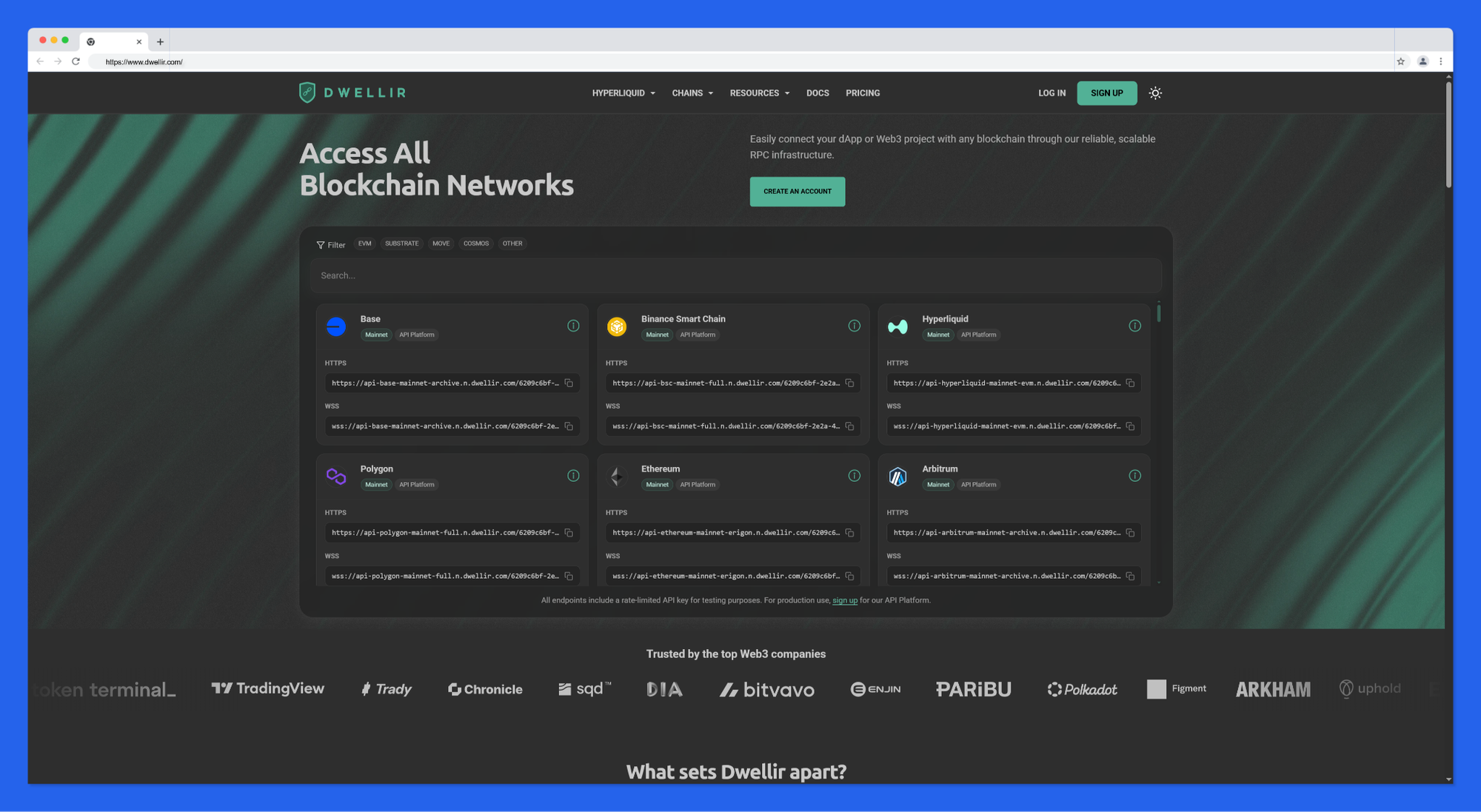
Dwellir bills one credit per response with no method weighting, so eth_getLogs and trace cost the same as eth_blockNumber. Plans: Free (500K responses per day, 20 RPS), Developer ($49, 25M, 100 RPS, 5perextra1M), Growth(299, 150M, 500 RPS, 3perextra1M), Scale(999, 500M, 5,000 RPS, $2 per extra 1M), Enterprise (custom). Unlimited Nodes are flat-rate per endpoint at $4.80 per RPS per month, from $119 (25 RPS) to a 1,000 RPS tier; a dedicated Ethereum archive cluster is listed at $12,600/mo. Trace and debug ship on every paid plan; crypto payment from Scale.
Best at: the cheapest entry price per request ($1.96 per 1M) and the simplest bill in the group. Loses on: no SOC 2 or ISO 27001 attestation found on its public pages, and the free tier is a daily cap, so a one-day burst over 500K returns 429s.
Chainstack
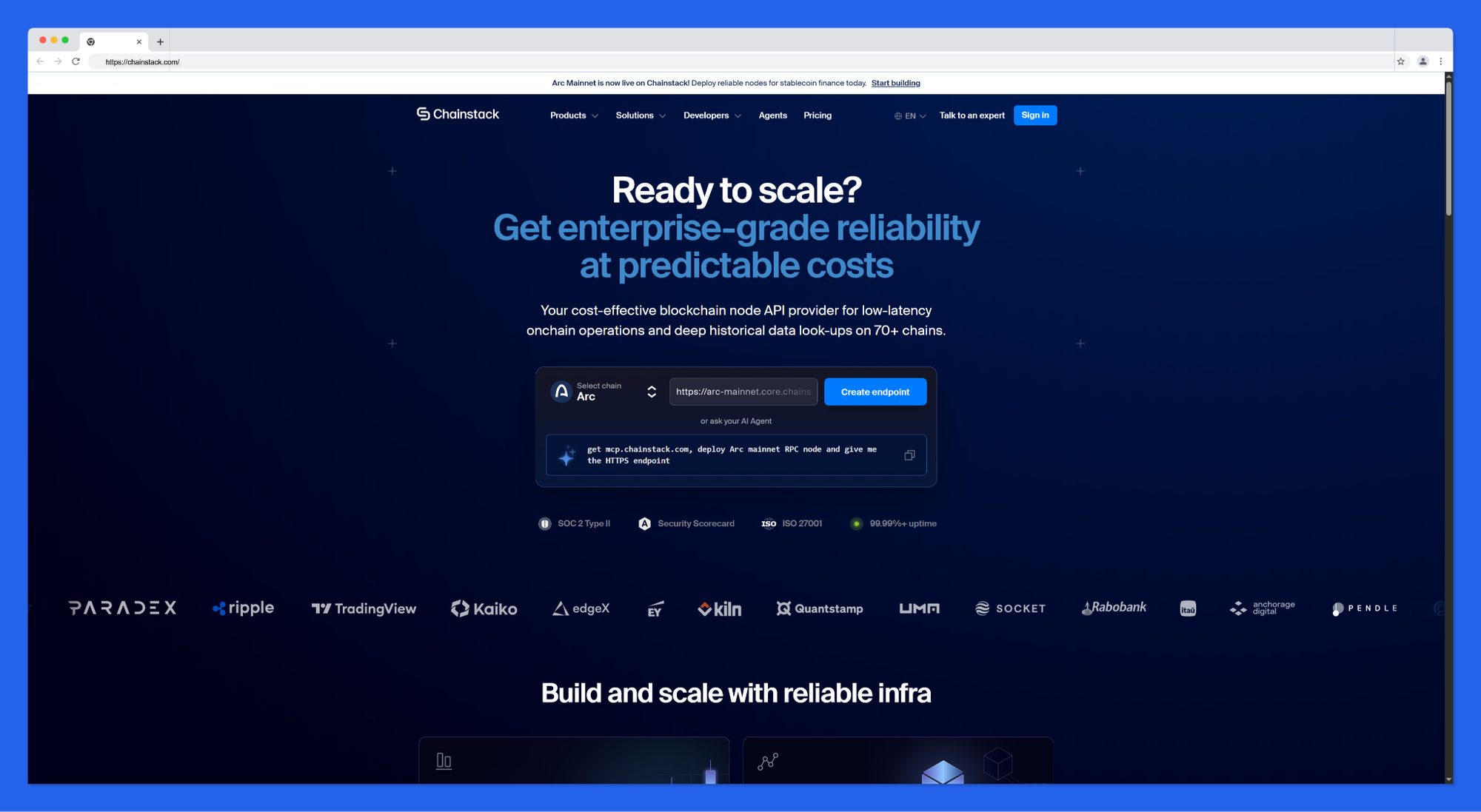
Chainstack bills 1 request unit per call on Global Nodes and Dedicated Nodes, and 2 per archive call. Plans: Developer (free, 3M RU, 25 RPS, 1 node), Growth ($49, 20M RU, 250 RPS, archive, debug and trace, add-ons, 15 per extra1M), Pro(199, 80M RU, 400 RPS, Dedicated Nodes, SSO, 12.50 per extra 1M), Business(499, 200M RU, 600 RPS, RBAC, $10 per extra 1M), Enterprise (from $990, 400M RU, custom RPS, uptime SLA, from $5 per extra 1M).
The Unlimited Node add-on from $149/mo at 25 RPS up to a 500 RPS tier removes metering on one endpoint.
Dedicated Nodes run from $0.50 per hour per node plus storage at $0.01 per 20 GB per hour; a Pay-as-you-go plan is offered to teams spending over $2,000/mo. Ethereum mainnet, Sepolia, and Hoodi, with faucets for both testnets, MEV protection free on Ethereum, and access rules for domain and IP allowlisting.
Best at: throughput per dollar at the $49 and $499 points (250 and 600 RPS), the only provider here with SOC 2 Type II and ISO 27001 published for every plan, and a public status page with measured 99.99%+ uptime. Loses on: 449–499 at 100M requests against 249–299 at OnFinality and Dwellir, a contractual SLA only on Enterprise, and Dedicated Nodes gated to Pro and above.
GetBlock
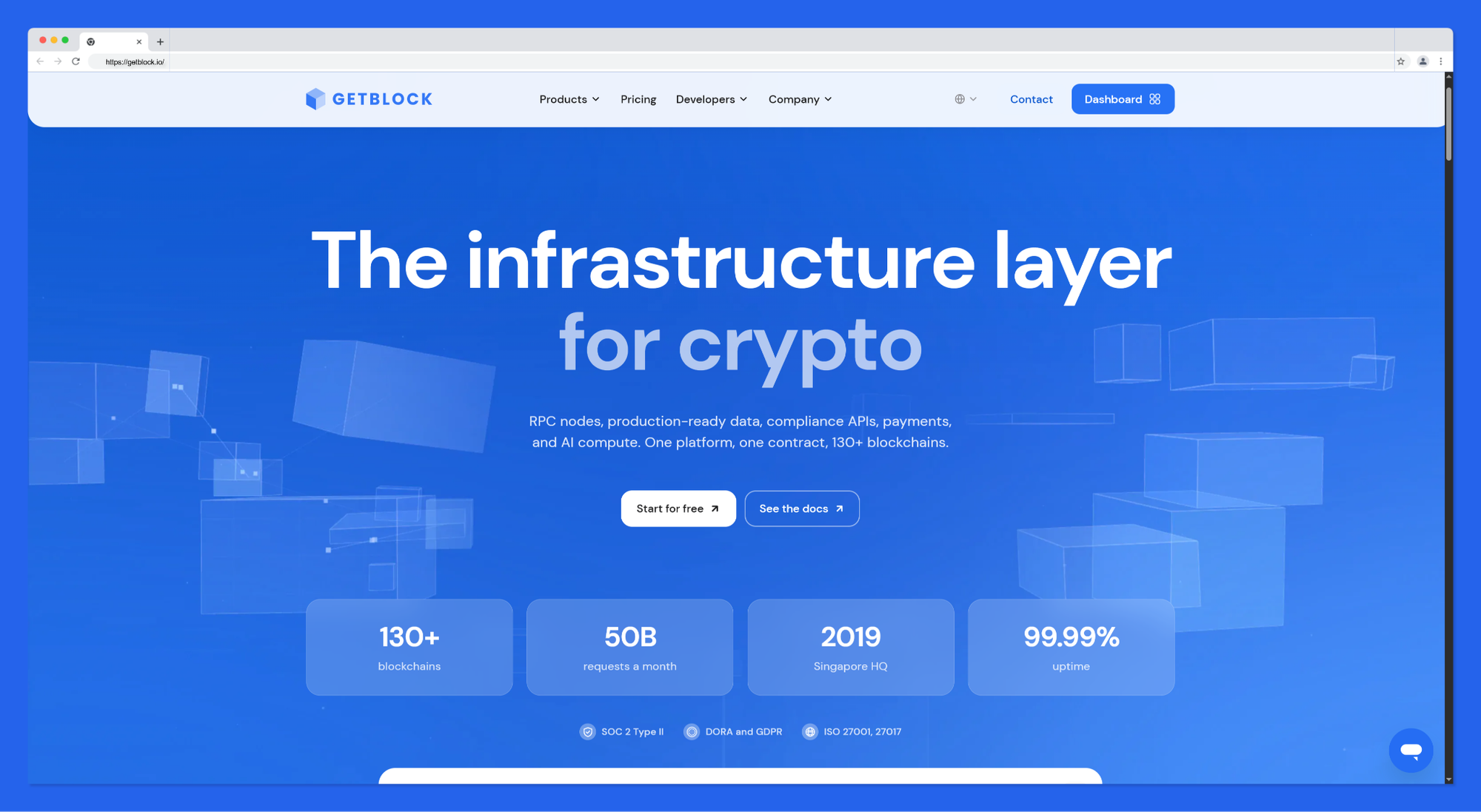
GetBlock meters shared plans in compute units: Ethereum carries a chain multiplier of 20, standard methods a method multiplier of 1, trace and debug 2, and archive endpoints double the total. Plans (RPS raised Jul 23, 2026): Free (50K CU per day, 20 RPS), Starter (49,90MCU,250RPS), Growth(99, 185M CU, 300 RPS), Advanced (199,385MCU,450RPS), Scale(349, 700M CU, 600 RPS), Pro ($499, 1B CU, 800 RPS, 0.40perextra1MCU), Premium(699, 1.6B CU, 800 RPS, $0.35 per extra 1M CU), Enterprise (from $999).
Limitless Node gives a fixed-RPS Ethereum endpoint with no metering from $150/mo (25 RPS full, 15 RPS archive); dedicated Ethereum nodes from $1,100 (full) and $1,300 (archive) with public configurator pricing. SOC 2 Type II attested in Q2 2026. Regional endpoints in Frankfurt, New York, and Singapore.
Best at: regional endpoint control on every plan, 800 RPS on self-serve, and published dedicated-node prices with no sales call. Loses on: 20 CU per Ethereum call makes the headline numbers 20x smaller than they look, so Starter's 90M CU is 4.5M requests and 100M requests runs about $839.
Quicknode
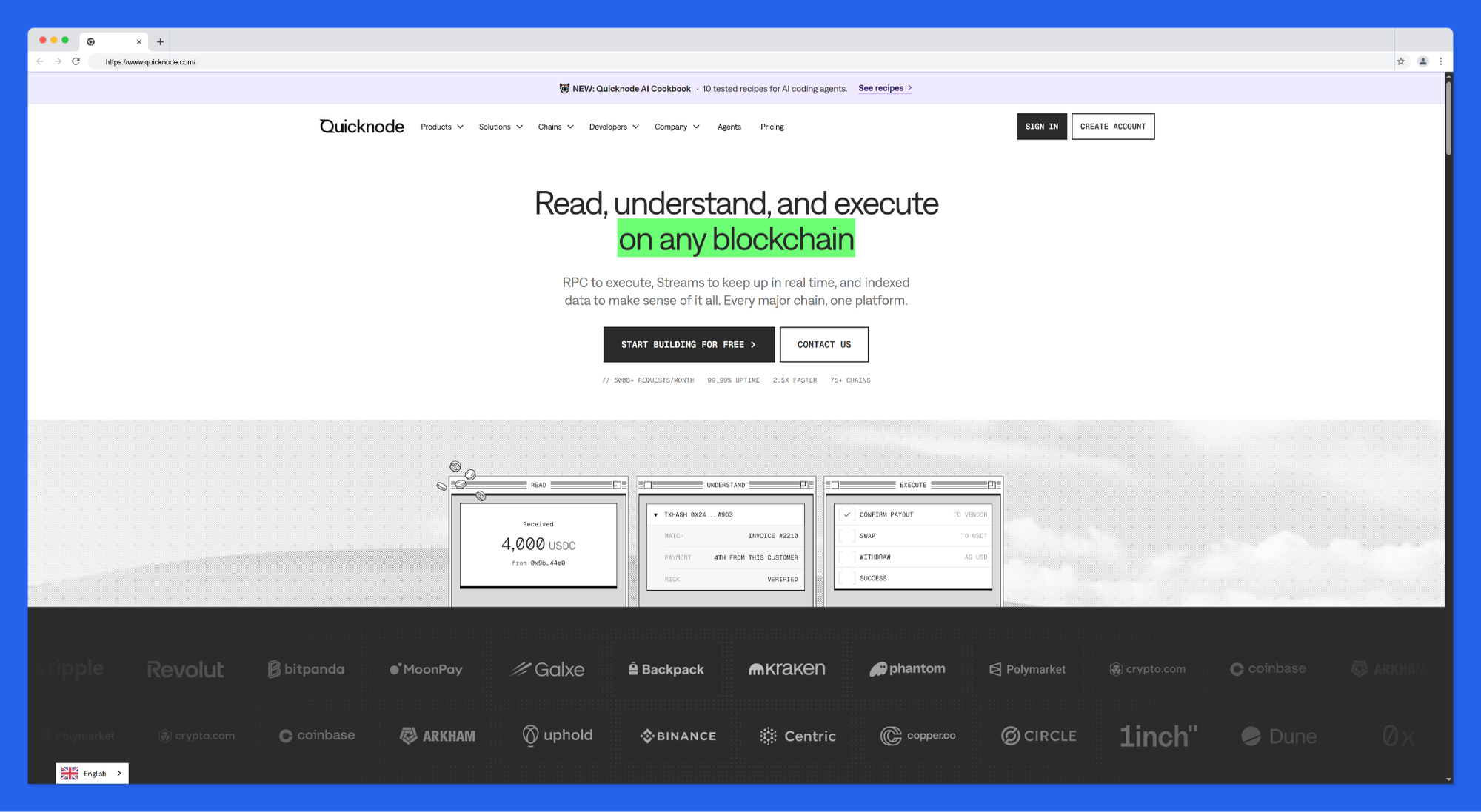
Quicknode prices in API credits at a flat 20 per Ethereum method, with trace and debug at 2x and a few replay methods at 4x. Plans: Free trial (10M credits, 15 RPS, one month), Build ($49, 80M credits, 50 RPS, 0.62perextra1Mcredits), Accelerate(249, 450M, 125 RPS, 0.56), Scale(499, 950M, 250 RPS, $0.53), Business (from $999, 2B, 500 RPS, $0.50), Enterprise (custom RPS, contractual SLA, SOC 1 and SOC 2 Type 2, ISO 27001, and DORA reports).
Streams, Webhooks, Key-Value Store, and IPFS are bundled; Dedicated Clusters, SSO, RBAC with custom roles, and Prometheus export are Enterprise.
Best at: the richest bundled data tooling (Streams with S3, PostgreSQL, and Kafka destinations) and the broadest audit set on Enterprise. Loses on: price per request ($12.25 per 1M on Build, $999 for 100M), the lowest entry RPS in the group (50), and no permanent free tier.
Alchemy
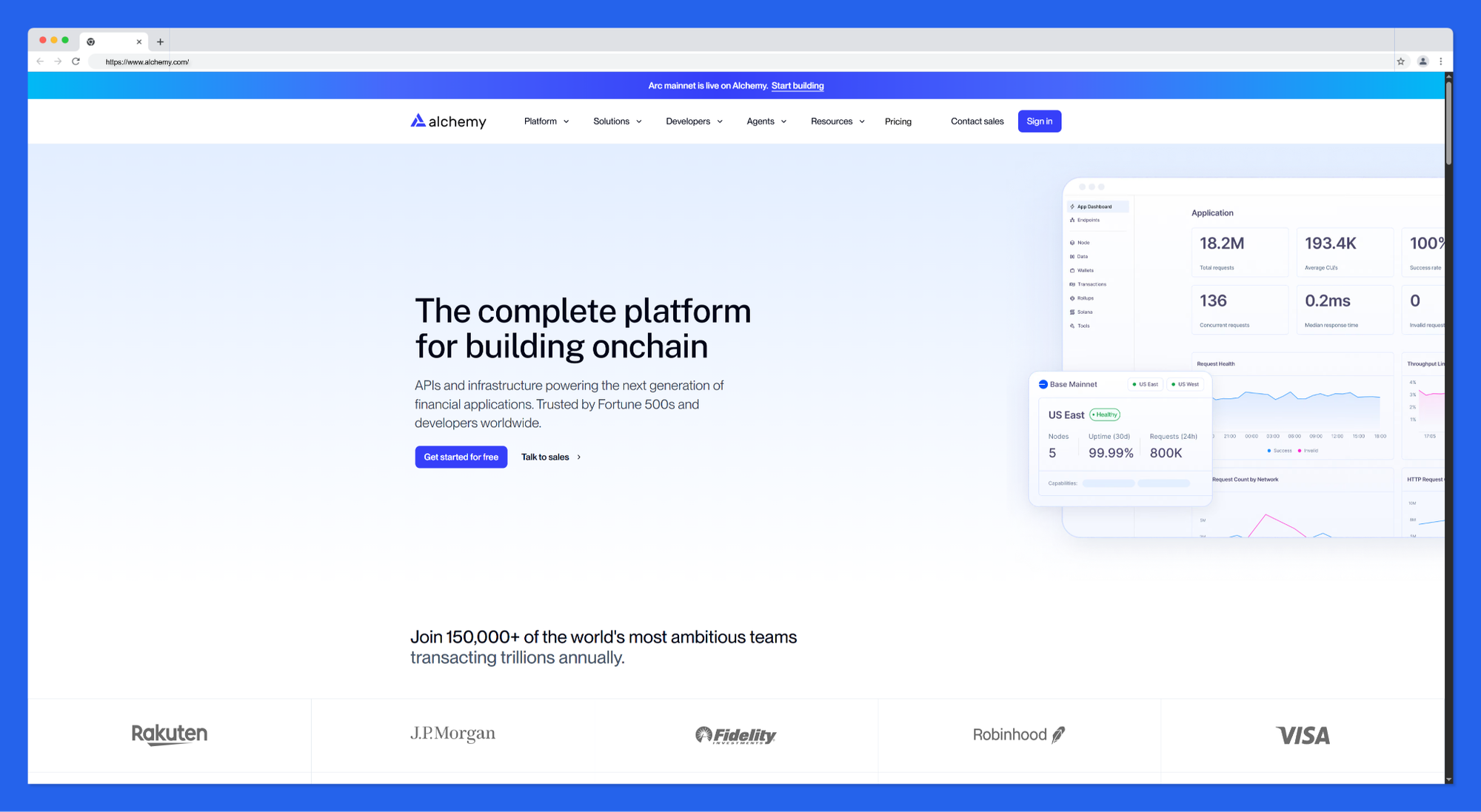
Alchemy has three tiers. Free: 30M CU per month, 15 RPS, 5 apps. Pay as You Go: $0.525 per 1M CU with 300 RPS (10,000 CU/s) included; each extra 5,000 CU/s block is $160/mo, self-serve capacity capped at 30,000 CU/s. Enterprise: from 1,000 RPS, signed SLAs, SAML SSO, RBAC. eth_call is 26 CU; Alchemy suggests 27 CU per request as a planning average. Trace and debug are not on Free. Data APIs (Token, Prices, Transfers, Portfolio, NFT), Webhooks, and Wallet APIs with gas sponsorship come with every tier.
Best at: the widest API surface beyond raw RPC and a no-commitment usage model. Loses on: 100M eth_call requests cost about $1,365, 300 RPS on Pay as You Go is the lowest self-serve ceiling after Quicknode Build, and throughput above that is bought in $160 blocks.
Ankr
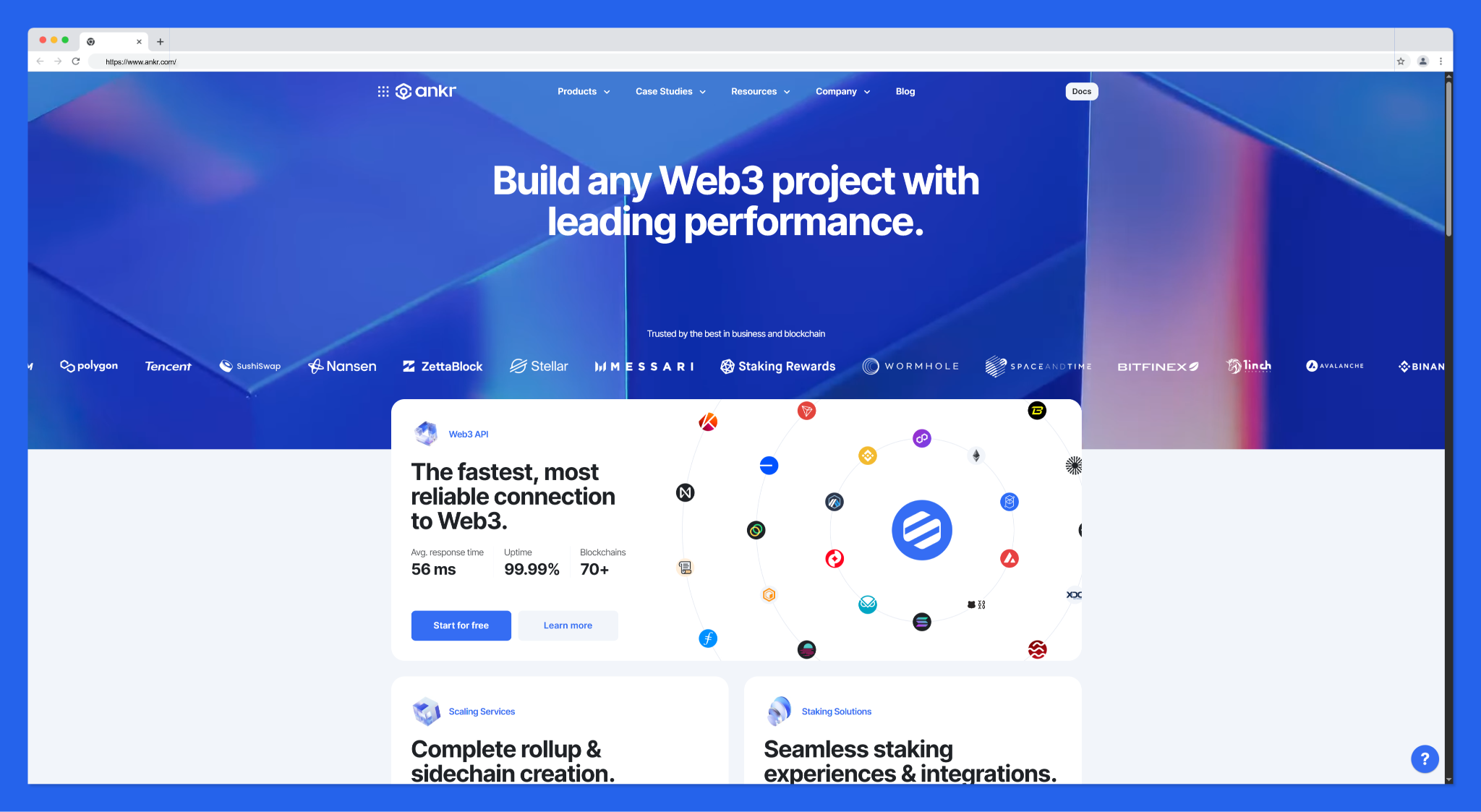
Ankr charges 200 API credits per EVM request on Premium at $0.10 per 1M credits, which is $20 per 1M requests, or 16.67 on prepaid (500 for 6B credits with 20% extra). Freemium gives 200M credits per month (1M requests) at roughly 30 RPS; Premium raises throughput to 1,500 RPS; Enterprise adds a contractual SLA. Payment in ANKR tokens is pegged to USD. Thirty-plus regions and 80+ chains on Premium.
Best at: 1,500 RPS with no plan to choose, and the broadest chain list. Loses on: the highest per-request price in the comparison, no monthly tiers to cap spend, and no SLA outside Enterprise.
Infura
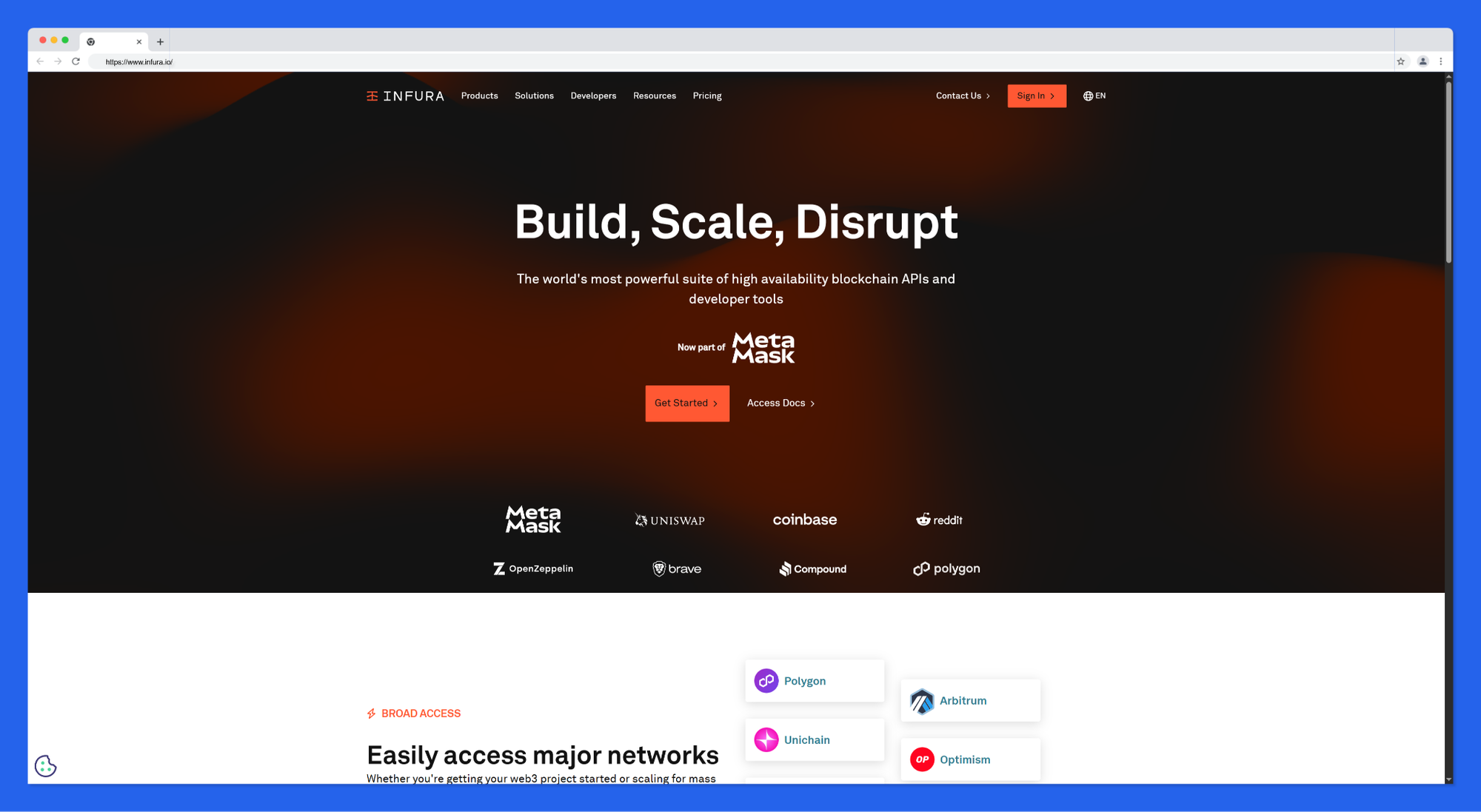
Infura (Consensys, MetaMask-native) prices in credits against a daily quota: Free (3M credits per day, 500 credits/s), Developer (50,15Mperday,4,000credits/s), Team(225, 75M per day, 40,000 credits/s), Custom. Every core Ethereum method is 80 credits, so Developer is about 187K requests per day (5.6M per month) at 50 RPS and Team about 937K per day (28M per month) at 500 RPS. Archive reads currently cost the same as non-archive. Failover forwarding to a partner provider is available on higher plans.
Best at: MetaMask integration and the longest Ethereum track record of the group. Loses on: a daily rather than monthly quota, no self-serve path to 100M requests per month, no SLA below Custom, and 80 credits per call, the heaviest weight here after Ankr.
Which Ethereum RPC provider should you choose?
There is no single best Ethereum RPC provider in 2026; the right pick depends on volume, throughput, and compliance.
- Under 100M requests per month on a tight budget: OnFinality (249) or Dwellir (299). Both lack a published audit attestation.
- Up to 600 RPS with audit reports on every plan: Chainstack. $49 buys 250 RPS, $499 buys 600 RPS, and SOC 2 Type II and ISO 27001 apply from the free tier up. Expect 449–499 at 100M requests, roughly 1.6x the cheapest option.
- Above 800 RPS on a shared plan: Dwellir Scale (5,000 RPS, $999), Ankr (1,500 RPS, usage-billed), or GetBlock (800 RPS on Pro). Above that, every provider moves you to dedicated or enterprise infrastructure.
- The broadest enterprise audit set: Quicknode, with SOC 1, SOC 2 Type 2, ISO 27001, and DORA on Enterprise, at the second-highest per-request price.
- Data tooling beyond RPC: Alchemy (Token, Prices, Transfers, Portfolio, Wallet APIs) or Quicknode (Streams to S3, PostgreSQL, Kafka).
- MetaMask-native: Infura, accepting a daily quota and no SLA on self-serve.
If you can, benchmark two finalists from your own region for a week before committing; none of the figures above measure latency.
FAQ
What is an Ethereum RPC provider?
A service that runs Ethereum nodes and exposes them over HTTPS and WebSocket using the JSON-RPC API, so an application can read chain state, estimate gas, and broadcast transactions without operating a node. Providers differ in how they meter calls (per request or per weighted unit), how much throughput a plan allows, and what uptime they commit to.
Which Ethereum RPC provider is cheapest?
For 100M eth_call-type requests per month on a shared plan, OnFinality (249) and Dwellir (299) as of Oct 15, 2026, followed by Chainstack (449–499). Credit-weighted providers cost more for the same mix: GetBlock about $839, Quicknode $999, Alchemy about $1,365, Ankr about 1,667–2,000; Infura has no self-serve plan at that volume.
Which Ethereum RPC provider has the best free tier?
By requests per month: Dwellir (about 15M at 500K per day), OnFinality (about 12M at 400K RU per day), and Chainstack (3M, with archive excluded). Alchemy's 30M CU is about 1.15M eth_call requests, Infura's 3M credits per day about 1.1M per month, and GetBlock's 50K CU per day about 75K per month.
Which Ethereum RPC providers are SOC 2 certified?
Chainstack publishes SOC 2 Type II and ISO 27001 for all plans. Quicknode provides SOC 1 and SOC 2 Type 2, ISO 27001, and DORA reports on Enterprise. GetBlock completed a SOC 2 Type II attestation in Q2 2026. Alchemy and Infura publish security pages not audited for this edition; no attestation was found on Dwellir, OnFinality, or Ankr pricing pages.
How do compute units compare to per-request billing?
One eth_call is 1 unit at Chainstack, Dwellir, and OnFinality, 20 at GetBlock and Quicknode, 26 at Alchemy, 80 at Infura, and 200 at Ankr. Divide a provider's included units by its weight to get comparable request counts; trace, debug, and archive calls carry further multipliers at most providers.
How do I connect to an Ethereum RPC endpoint?
Create an account with the provider, create an Ethereum mainnet (or Sepolia or Hoodi) endpoint, and paste the HTTPS or WSS URL into your client, for example provider = Web3(HTTPProvider(url)) in web3.py or new JsonRpcProvider(url) in ethers.js. Keep the URL in an environment variable; it carries your key. On Chainstack, deploy a Global Node from the Chainstack account and copy the endpoint from the node page; the Ethereum getting-started reference covers the first calls.
Sources and further reading
Pricing pages opened Oct 15, 2026: Chainstack, Dwellir and Dwellir docs, OnFinality, GetBlock and GetBlock CU model, Quicknode and Quicknode API credits, Alchemy, Ankr, Infura plans and Infura credit costs.
- Ethereum JSON-RPC specification on ethereum.org
- Ethereum API reference on Chainstack
- Ethereum tooling guide: wallets, SDKs, and libraries
- Chainstack status page for measured uptime history
About Ormi
Ormi is the next-generation data layer for Web3, purpose-built for real-time, high-throughput applications like DeFi, gaming, wallets, and on-chain infrastructure. Its hybrid architecture ensures sub-30ms latency and up to 4,000 RPS for live subgraph indexing.
With 99.9% uptime and deployments across ecosystems representing $50B+ in TVL and $100B+ in annual transaction volume, Ormi is trusted to power the most demanding production environments without throttling or delay.